Why a Vest That Fits Perfectly in a Shop Fails in the First Mile
Quick Answer: A vest is fitted to a still, shallow-breathing torso and then used on a rotating torso taking much deeper breaths, with a load that settles and shifts within the first mile. Rib expansion at running effort is several centimetres more than at rest, and torso rotation moves the shoulder straps against each other with every stride. A vest that has no slack at standstill will be too tight to breathe into and will chafe where the straps cross.
Fit it to the running body, not the standing one.
Here is how to test it properly.

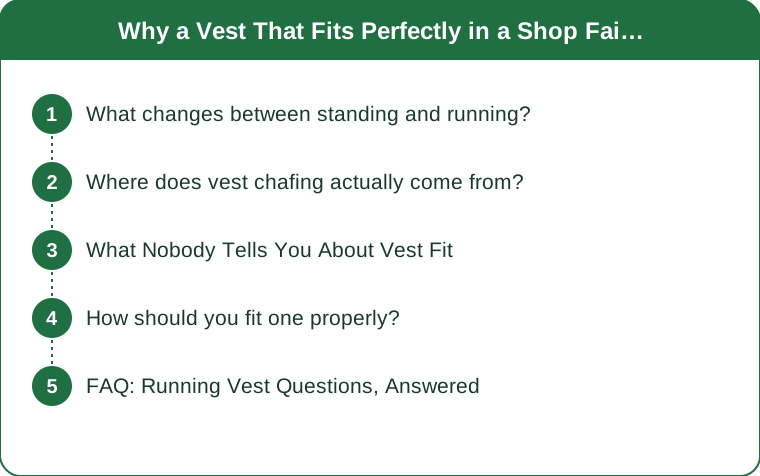
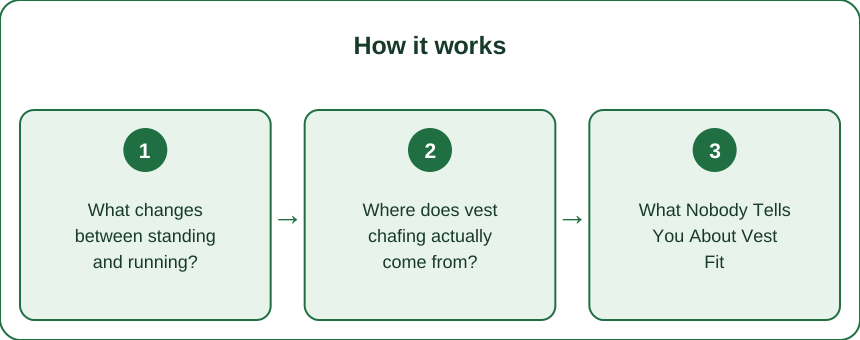
What changes between standing and running?
Rib expansion increases substantially. Deep running breaths expand the lower ribs by a noticeably larger circumference than resting breaths, and a vest fitted at rest has nowhere to accommodate that.
The torso rotates with every stride. Each shoulder alternately moves forward, which slides the straps against each other and against your skin thousands of times per hour.
Load settles downward and forward. Soft flasks compress, contents shift, and the load that sat neatly at your chest in the shop sits lower and looser after a mile.
Flasks empty asymmetrically. Most people drink from one side more, which changes the balance progressively through the run.
You get wet. Sweat changes friction at every contact point and adds weight in the fabric itself.
And your clothing changes underneath. A vest fitted over a t-shirt behaves differently over a jacket, which is exactly the transition autumn brings.
Where does vest chafing actually come from?
Strap crossover points, not strap tension. Where the front straps meet the chest and where the shoulder straps cross the collarbone are the two highest-friction zones, and both are motion-driven rather than pressure-driven.
Seams sitting on a moving joint. Any seam over the collarbone or the front of the shoulder will be rubbed by rotation regardless of how well the vest fits.
Wet fabric against wet skin. As with all chafing, moisture is the multiplier.
An underfilled vest bouncing. A half-empty vest moves far more than a full one, which is why the second half of a long run is when chafing usually starts.
Layers bunching underneath. A jacket hem or a bunched base layer under a strap creates a ridge, and the ridge does the damage.
And straps tightened to stop bouncing. The instinctive fix for bounce is more tension, which increases pressure at the friction points and usually makes it worse.

What Nobody Tells You About Vest Fit
A vest should be fitted with the flasks full and after five minutes of movement, not empty and standing still. This single change resolves most fit complaints, because it is the only way to see where the load actually settles.
Bounce is a load-distribution problem, not a tension problem. If it bounces, move weight higher and closer to your chest before tightening anything. Tightening a badly distributed load just presses it against you while it still moves.
A half-empty vest is the worst-case scenario and it is also the normal one. Pack so that the vest is stable when partly empty, which usually means filling dead space rather than removing weight.
The rear pocket is where most instability originates. A jacket stuffed loosely in the back moves independently of the vest and drags at the shoulders with every stride.
Autumn layering changes fit enough to require refitting. A vest dialled in over a summer vest top will sit differently over a long-sleeve and a jacket, and most people never readjust.
Sizing down for a snugger fit is usually the wrong answer. It reduces the space your ribs need at running effort, and breathing restriction is a much bigger problem than mild movement.
And the test that matters is a downhill. Flat running hides instability. Two minutes of downhill running reveals everything a fitting room cannot.
How should you fit one properly?
Fill the flasks and load it as you would for a real run. Empty-vest fitting tells you almost nothing.
Wear the layers you will actually run in. Refit at the start of each season, not once when you bought it.
Run for five minutes, then adjust. Load settles in the first mile, so any adjustment made before that is provisional.
Test on a downhill. If it is stable descending, it is stable everywhere.
Take a deep breath at full effort and check for restriction. If you cannot expand your lower ribs fully, it is too tight regardless of how it feels standing.
Fill dead space rather than tightening straps when the vest is partly empty. A soft layer in the back pocket stabilises far better than tension does.
And apply balm to the crossover points before long runs, because those points are friction-driven and no fit eliminates them entirely.
FAQ: Running Vest Questions, Answered
Why does my vest bounce only when it is half empty?
A partly empty vest has dead space for contents to move in. Fill the space with a soft layer rather than tightening the straps.
Should I size down if my vest moves?
Usually not. A smaller size restricts rib expansion at running effort, which is a bigger problem than mild movement.
Where should I put the heaviest items?
High and close to your chest and upper back. Weight low and away from the body is what drives bounce.
Why does my vest chafe on one side only?
Most people drink from one flask more, and torso rotation is rarely perfectly symmetrical. Both create a one-sided friction pattern.
Do I need to refit for autumn?
Yes. A vest dialled in over a summer top sits differently over a long-sleeve and a jacket.
How do I test a vest properly before a long run?
Load it fully, run five minutes, adjust, then run two minutes downhill. Flat running hides almost every problem.
TL;DR:
- Running expands your ribs and rotates your torso; a vest fitted standing still has no room for either.
- Chafing comes from strap crossover points and motion, not from tension.
- Bounce is a load-distribution problem; move weight high and close before tightening anything.
- A half-empty vest is the unstable case, so fill dead space rather than removing weight.
- Refit for autumn layers, and test on a downhill rather than on the flat.
- Restricted rib expansion is a worse outcome than mild movement, so do not size down to fix bounce.
Fit it loaded, moving, and in the clothes you will actually wear.
Keep Reading
This article is for general informational and styling purposes only. Fit, sizing, and product availability may vary.