Why Washing Your Vest Changes How It Fits
Quick Answer: Sweat salt, body oils and compressed foam all change how a vest sits. Washing removes the salt crust that was adding grip and stiffness, and it lets compressed padding partially recover, so a clean vest genuinely fits and behaves differently from a dirty one. It needs re-adjusting after a wash — not replacing — and the elastic will also have relaxed with age, which washing reveals rather than causes.
Six months of not washing it, one wash, and suddenly it moves on every descent.
Both of those facts are related and neither means the vest is finished.


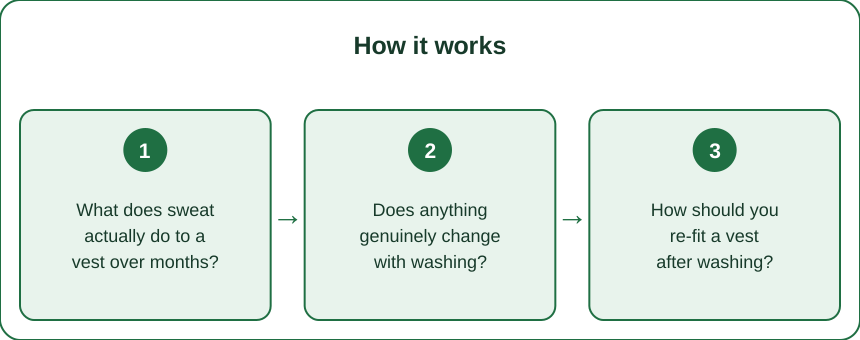
What does sweat actually do to a vest over months?
It leaves a crust, and the crust is doing more than you would think.
Sweat is mostly water and salt, and the water evaporates. What stays behind accumulates in the fabric, and over months it builds into a genuine deposit — visible as white marks on straps and around the shoulders, and detectable as a stiffness in the material.
That deposit changes the fabric’s behaviour. Salted fabric is stiffer and has a higher friction coefficient against clothing than clean fabric. The vest is effectively gripping your shirt slightly better because it is dirty, and that grip has been contributing to its stability.
Body oils do something similar in the opposite direction on some surfaces, and combined with salt they change how straps slide through adjusters. A vest that has not been washed often has adjusters that are effectively half-locked, so the settings hold better than they should.
Wash all of that out and you get a clean, softer, more slippery vest that needs its adjustments properly set rather than relying on friction. This reads as the vest getting worse and is actually the vest returning to its designed behaviour.
There is also the smell, which is the reason most people finally wash it. Bacteria living in the accumulated organic material are the source, and no amount of airing removes them once established.
Does anything genuinely change with washing?
Yes — foam recovery and elastic, and one of those is permanent.
Padding compresses with use and recovers partially when washed and dried. The foam in shoulder straps and back panels takes a set under repeated load, and a wash cycle plus a proper dry restores some loft. A vest that has recovered loft sits differently on your shoulders, which changes where the load sits and how the straps need to be set.
Elastic degrades with time, heat and sweat exposure, and this is not reversible. The elastic in a vest’s side panels and pockets stretches out over months, and washing does not damage it further in any meaningful way — but a clean vest makes the loss obvious. People blame the wash for something that had already happened.
Hot water and machine washing genuinely can damage a vest, which is where the fear comes from. High heat degrades elastic faster, and a machine cycle with a zip or a buckle loose can abrade fabric. Cold water, hand wash or a gentle cycle in a mesh bag, and air drying away from direct heat is the standard approach and it does not harm anything.
Detergent residue matters here too. Ordinary detergent leaves surfactants that make fabric hold moisture, which is unhelpful in a garment worn against skin. A technical wash or a very small amount of mild detergent, with an extra rinse, is better.
So the honest summary: washing changes the fit, restores some function, and reveals age-related elastic loss that had already happened.
How should you re-fit a vest after washing?
From scratch, in the state you will actually run in, which is the step everyone skips.
Fit it loaded, not empty. A vest with full flasks and a jacket in the back sits completely differently from an empty one. The single most common fitting error is adjusting an empty vest, which produces something that is too tight when loaded or bounces when half-empty.
Fit it over the clothing you will wear. Autumn means more layers, and a vest set over a summer singlet is wrong over a long-sleeved base and a jacket. This alone accounts for a lot of October bounce complaints.
Set the sternum straps last and highest first. The upper strap does most of the stability work; the lower one prevents spread. Both should be snug enough that the vest does not lift when you jump, and loose enough that breathing is unrestricted — test both by jumping and by taking a deliberate deep breath.
Check it again at halfway on your first run after washing. Clean straps slip more through adjusters until they take up a little surface texture again, so a mid-run tighten is normal on the first outing.
And check the side adjusters, which most people never touch. They control how the vest wraps rather than how tight it is, and a vest that bounces despite tight shoulder straps is usually a wrapping problem rather than a tension one.

How often should you wash it, then?
More often than most people do, and with a routine that makes it happen.
Rinse after every sweaty run. Not a wash — a rinse in cold water, thirty seconds, then hang to dry. This is the single habit that prevents the salt build-up and the smell, and it takes less time than filling the flasks did.
Proper wash every ten to fifteen uses, or whenever it smells before you have put it on. Cold water, technical wash or a tiny amount of mild detergent, extra rinse, air dry.
Dry it properly and completely. A vest hung damp in a dark place is how bacteria establish, and a partially dry back panel will smell within days. Hang it open, upside down if the design allows, somewhere with moving air.
Flasks and bladders need separate attention and are the more common source of genuine problems. Anything with a bite valve or a tube needs cleaning after every use with a sports drink or anything other than water, and thorough drying between uses. Mould in a bladder tube is a real and unpleasant possibility and is entirely preventable.
Store it hanging, not stuffed. A vest compressed in a drawer all winter takes a set in the folds, and the elastic degrades faster under sustained tension.
5 Mistakes Everyone Makes With Vest Care
1. Never washing it because washing might damage it. The damage from months of salt and bacteria is greater and more certain than the damage from a careful cold wash. This fear costs people vests.
2. Machine washing it hot with everything else. Heat degrades elastic, and buckles in a drum with other laundry abrade both. Cold, gentle, mesh bag, and everything zipped and clipped closed.
3. Drying it on a radiator. Direct heat is the fastest way to age elastic and any laminated fabrics. Air dry, away from heat sources.
4. Leaving flasks in the vest between runs. A partly full flask in a pocket for a week is a hygiene problem and it deforms the pocket. Empty, rinse, dry, and store separately.
5. Re-fitting the vest empty after a wash. A vest fitted empty will always be wrong when loaded, and this is the reason a clean vest so often feels worse than a dirty one. Load it, layer up, and set it properly once.
FAQ: Running Vest Care Questions, Answered
Can I put my vest in the washing machine?
Most can go on a cold gentle cycle in a mesh bag with everything closed, but check the manufacturer’s instructions, because some constructions genuinely do not tolerate it. Hand washing in cold water is universally safe and takes five minutes.
Why does it smell even after washing?
Bacteria embedded in foam padding are hard to reach with a surface wash. A longer soak in cold water with a technical sports wash, or a dedicated odour-eliminating product, usually works. Complete drying afterwards is essential or it returns immediately.
The elastic has gone. Is that fixable?
Generally not. Elastic degradation is permanent and it is the usual reason a vest reaches the end of its life. Some manufacturers replace elastic panels; most do not.
Should I wash a new vest before using it?
No need, and there is no harm in it either. What matters more is fitting it loaded and layered before its first long run rather than discovering the fit at kilometre ten.
How do I stop the front pockets stretching out?
Avoid storing full flasks in them and avoid forcing oversized items in. Pocket elastic is the first thing to go on most vests, and it goes fastest under sustained rather than repeated stretch.
Does washing affect water resistance on the back panel?
Some vests have a treated back panel that behaves like a jacket finish, and it can be restored the same way with a spray-on treatment. Most do not, and are simply fabric.
TL;DR:
- Accumulated sweat salt stiffens fabric and adds grip, so a dirty vest is genuinely more stable than a clean one — until it smells.
- Washing restores some foam loft and reveals elastic that had already degraded; it does not cause the loss.
- Re-fit from scratch after a wash, loaded and over the clothing you will actually wear, and re-check at halfway on the first run.
- Rinse after every sweaty run and do a proper cold wash every ten to fifteen uses.
- Flasks and bladders need more attention than the vest itself, and complete drying is what prevents the smell returning.
Rinse your vest under a cold tap after your next run and hang it open — that one habit prevents most of what this article is about.
Keep Reading
This article is for general informational and styling purposes only. Fit, sizing, and product availability may vary.