Why Your Running Vest Feels Tighter at Mile Ten Than Mile One
Quick Answer: Three things change over a long run. Your breathing shifts from shallow upper-chest to deeper rib expansion, so your chest circumference at full inhale grows. Your torso swells slightly with blood flow and heat. And the vest’s own webbing softens and its load redistributes as the flasks empty, which moves weight without loosening the straps. The result is a vest that measures the same and feels tighter. Set it up one notch looser than feels right and plan to adjust at the first climb.
Nothing tightened. Your ribcage got bigger.

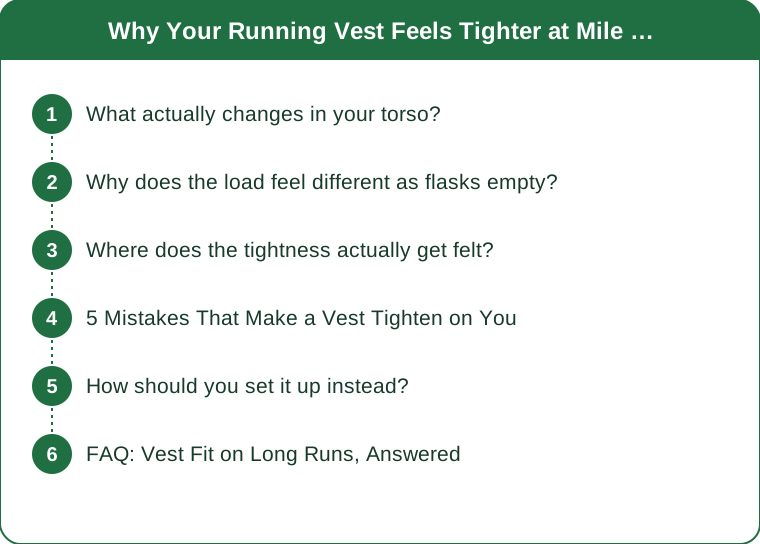
What actually changes in your torso?
Breathing depth increases as effort accumulates, and deeper breathing means more rib expansion on every inhale.
Early in a run most people breathe shallowly, mainly at the top of the chest, so the vest is fitted against a smaller circumference than it will later encounter.
Rib expansion at full effort can exceed several centimetres, which is more than most sternum strap adjustments span.
Blood flow to the torso and skin increases with heat, adding a small but real volume change.
Any food or fluid you take on adds abdominal volume, which matters for lower straps and bottom-of-vest pressure.
And posture changes with fatigue - a rounder upper back late in a run alters where the straps sit against the ribs entirely.
Why does the load feel different as flasks empty?
A full front flask sits low and stable. A half-empty one sloshes and its centre of mass moves with each step.
As front weight drops, the vest rides higher, and a vest sitting higher puts the sternum strap in a new place on the chest.
Back load stays put while front load disappears, so the balance shifts backwards and the shoulder straps take a different angle.
Straps that were correct for the loaded balance are wrong for the unloaded one, which is why the vest can feel simultaneously tighter across the chest and looser at the shoulders.
Webbing softens as it absorbs sweat, changing how it distributes pressure even at the same setting.
And layers come off during the run, removing a centimetre or two of padding between webbing and skin.
Where does the tightness actually get felt?
The sternum strap is the usual culprit, because it crosses exactly where rib expansion is largest.
A strap set too high presses on the upper chest and restricts the part of the ribcage that expands most at high effort.
A strap set too low sits over the lower ribs, which move more but tolerate pressure better - which is why a lower setting often feels easier late.
Shoulder straps produce a different sensation - a dull ache rather than restriction - and that one is a load balance problem.
Side pressure at the lower ribs usually means the vest is riding up, not that the vest is too small.
And genuine breathing restriction shows as an inability to take a full breath at the top, which is worth stopping to fix rather than running through.

5 Mistakes That Make a Vest Tighten on You
Mistake one: fitting it at rest. A vest fitted while standing still is fitted to the smallest ribcage you will have all day.
Mistake two: setting the sternum strap where it feels most secure. Maximum security is usually maximum restriction, and the difference only shows at mile eight.
Mistake three: one sternum strap position for the whole run. Most vests have a rail for exactly this reason and almost nobody uses it.
Mistake four: filling front flasks completely and leaving back load fixed. As the front empties the balance shifts, and there is no adjustment that covers both states.
Mistake five: tightening when it starts to bounce. Bounce late in a run is usually a loading problem from emptying flasks - tightening makes the restriction worse without fixing the bounce.
And the persistent one: never adjusting mid-run. Ten seconds at the top of the first climb is cheaper than two hours of squeezed ribs.
How should you set it up instead?
Fit it after ten minutes of running, not at the car. Take a full deep breath and set the sternum strap so you can still expand fully.
Position the sternum strap over the lower part of the sternum, not high on the chest, and use the rail if there is one.
Set it one notch looser than feels right at the start. It will feel correct within twenty minutes.
Move front weight to the back as flasks empty rather than leaving a lopsided load.
Adjust at a fixed checkpoint - the top of the first climb - so it becomes routine rather than a reaction.
Take one full deep breath at every adjustment as the test, since that is the state that has to work.
And if you cannot get a full breath, stop and loosen it properly rather than shortening your breathing to fit the vest. This is general information, not medical advice.
FAQ: Vest Fit on Long Runs, Answered
Why does my vest get tighter as the run goes on?
Breathing gets deeper, so your chest at full inhale is larger than it was when you fitted the vest at rest.
Where should the sternum strap sit?
Over the lower sternum, not high on the chest. Higher restricts the part of the ribcage that expands most.
Should I fit my vest before or after warming up?
After about ten minutes of running, taking a full deep breath as the test.
My vest bounces late in a run - should I tighten it?
Usually not. Late bounce comes from half-empty flasks. Redistribute the load instead.
How often should I adjust mid-run?
At least once, at a predictable point like the first climb. It takes ten seconds.
When is tightness a real problem?
When you cannot take a full breath at the top. Stop and loosen rather than adapting your breathing to it. This is general information, not medical advice.
TL;DR:
- Breathing gets deeper over a long run, so your chest at full inhale is larger than when you fitted the vest standing still.
- Emptying front flasks shift the load backwards and let the vest ride higher, moving the sternum strap into a worse position.
- Fit the vest after ten minutes of running, one notch looser than feels right, with the sternum strap over the lower sternum.
- Late-run bounce is a loading problem, not a tightness problem - redistributing beats tightening.
- Adjust at a fixed checkpoint and use a full deep breath as the test.
If you cannot take a full breath, that is not toughness. Stop and loosen it. This is general information, not medical advice.
Keep Reading
This article is for general informational and styling purposes only. Fit, sizing, and product availability may vary.