Racing With a Hydration Vest: The Setup, Strategy and Aid-Station Craft
Quick Answer: Race the vest you trained in. Pack mandatory kit first, keep heavy items high and against your back, put the next two hours of fuel in the front chest pockets, and run two soft flasks (one water, one electrolyte) for fast aid-station refills. Decide what you need before you arrive at each station — fill, fuel, trash, go — because ten stations at three minutes each is half an hour of standing still.
There are two kinds of vests at any trail start line. One disappears by kilometer three. The other announces itself every single stride for six hours.
The difference isn’t the brand. It’s about 40 minutes of setup you either did or didn’t do.

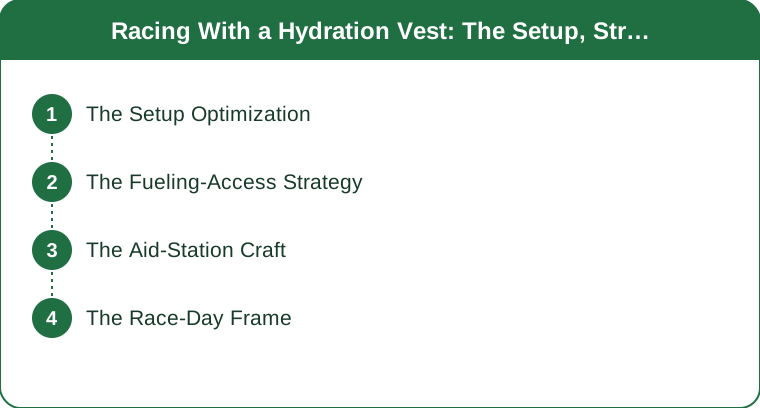
How should you set up a race vest?
Mandatory kit goes in first. Jacket, whistle, emergency blanket, whatever the race requires — pack it before anything else, so you’re never rearranging it at 5am. Do a kit check against the written list the night before and again in the morning.
Weight goes high and against your back. Heavy items low or loose is what creates bounce. Soft flasks balance the load on the front. Once it’s loaded, jog 100 meters at race effort in your kitchen or driveway — bounce that’s tolerable at a walk becomes maddening at hour four. Retune the straps with the vest full, not empty.
Map your access. Everything you’ll need while moving must be reachable while moving: gels in the front pockets, phone zipped but reachable, jacket in the back stretch pocket. Anything that requires stopping should be something you genuinely only need once.
Flasks beat a bladder for most races. Refills are faster, you can see your fluid level, and you can carry two different drinks. A bladder makes sense for long unsupported sections where you’re carrying 2 liters between water sources.
Nothing new on race day. The race vest is the training vest — same fit, same chafe points, same pocket muscle memory. A brand-new vest on race morning is the most avoidable mistake in the sport.
Balm the hot spots. Collarbone, sternum edge and lower ribs where the straps sit. For anything past 50k, some runners tape those points preemptively.
How do you fuel from a vest while moving?
Front pockets hold the next two hours only. A gel every 30 to 40 minutes means roughly three to four gels within reach at any time. Everything beyond that lives in the back and gets restocked at aid stations. Wrappers go in one dedicated trash pocket — pick the same one every time.
Sip small and often. The aid-station chug is how you get sloshing and nausea. Two flasks — plain water in one, electrolyte mix in the other — lets you drink to thirst without over-concentrating. On long climbs, where it’s easy to forget, set a mental sip trigger like every switchback.
Pre-open your solid food. Score or unwrap chews and bars in advance. At hour six, with cold or swollen fingers, a tightly sealed wrapper is genuinely a problem. Test the whole system with cold hands at least once in training.
Coordinate drop bags with vest capacity. Map your resupply points, then work out what you actually carry versus what waits for you. Carrying an extra 400g of “just in case” for 40 kilometers has a real cost.
Practice fueling from the vest on long runs. Same pockets, same timing, same products. You’re training your gut and your hands at once.

What’s the fastest way through an aid station?
Decide before you arrive. The mental checklist is four words: fill, fuel, trash, go.
Approach with flasks already out and lids off. This alone saves 20 to 30 seconds per station. Hand both to a volunteer at once rather than one at a time.
Target 30 seconds for short races, 2 minutes maximum for ultras. Anything longer and you’re socializing, which is fine — just know you’re choosing it.
Do not sit in the chair. The chair is where races end. If you need to sit, set a timer first.
Restock systematically. Same pocket every time, especially under fatigue when your judgment is worse than you think. Before you leave: flasks seated, pockets zipped, trash cleared. Say it out loud if you have to.
Do the math once and it changes your behavior. Ten aid stations at three minutes is 30 minutes standing still. That’s often more time than you’d gain from a month of extra training.
Thank the volunteers and leave the station clean. Non-negotiable, and it costs nothing.
5 Mistakes Everyone Makes With Race Vests
- Racing in an untested vest. Fit, chafe points and pocket layout all need rehearsal. This is the classic error and it’s completely free to avoid.
- Loading heavy items low. Bounce comes from weight that’s far from your center of mass. High and tight, always.
- Never re-tightening mid-race. As flasks empty, the vest loosens and starts to move. A 10-second strap tug every couple of hours prevents hours of chafe.
- Packing “just in case” items you’ve never used. Review your vest after every race and note what you carried and never touched. Next race, it stays home.
- Skipping the hourly self-check. Fluids, fuel count, hot spots. Small problems caught at hour two are trivial; caught at hour five they’re race-ending.
What about race-day conditions and the finish?
Keep the weather-turn gear in a quick-access pocket, not buried. In mountain races the packable jacket may be both mandatory and genuinely necessary within minutes of a weather shift — if you have to stop and unpack to reach it, it’s in the wrong place.
Run an hourly audit: how much fluid is left, how many gels have you taken, is anything starting to rub. Re-tension straps as the load lightens.
At the finish, empty the vest and take stock. What did you carry the whole way and never use? What did you run out of? That two-minute debrief is how the next race gets packed better.
A well-set vest disappears. You stop noticing it around kilometer three and don’t think about it again — which is exactly the point. The gear that’s rehearsed becomes invisible, and the kilometers stop being interrupted by fumbling.
FAQ
How much water should I carry in a race vest?
Two 500ml soft flasks (1 liter total) covers most supported races with aid stations every 8 to 12 kilometers. For unsupported sections longer than about 90 minutes, add a 1.5 to 2 liter bladder or a third flask.
Should I use flasks or a bladder for racing?
Flasks for most races — faster refills, visible levels, and you can carry two different drinks. Bladders win when you need large volume between water sources and won’t be refilling often.
How do I stop a hydration vest from bouncing?
Load heavy items high and against your back, tighten the sternum and side straps with the vest fully loaded, and test at race effort rather than at a walk. Persistent bounce with a correctly loaded vest usually means the size is wrong.
TL;DR:
- Race the vest you trained in. No new gear on race day, ever.
- Mandatory kit first; heavy weight high and tight; test bounce at race effort with a full load.
- Front pockets = next two hours of fuel. Two flasks: one water, one electrolyte.
- Aid stations: decide before arriving, then fill, fuel, trash, go. 30 seconds short races, 2 minutes max for ultras.
- Ten stations at 3 minutes = 30 minutes of standing. Efficiency here is free speed.
Keep Reading
This article is for general informational and styling purposes only. Fit, sizing, and product availability may vary.