Why Your Running Vest Makes You Overheat in Summer — and the 2-Minute Fix
Quick Answer: A running vest overheats you in summer mainly because the back panel traps heat against your spine. Loosen the sternum straps one notch, switch to a mesh-back vest if you own one, and move bottles to the front to let the back breathe.
The same vest that felt weightless on a cool spring morning turns into a portable sauna once July hits. You’re not imagining it — and it’s not really about the vest’s weight. It’s about what’s happening against your back for the entire run.

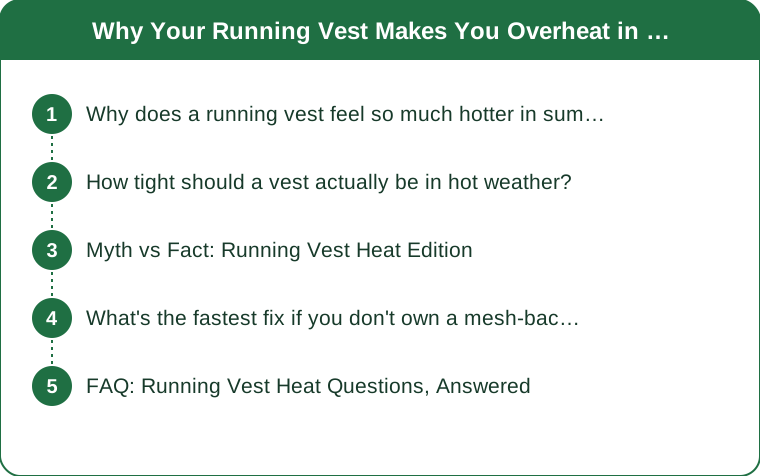
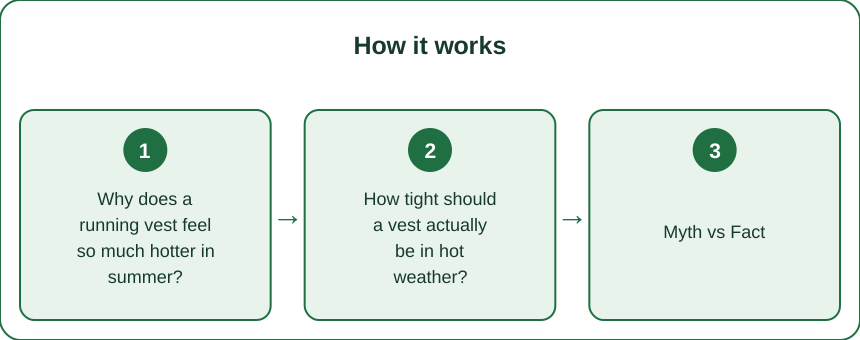
Why does a running vest feel so much hotter in summer?
Your back is one of the body’s biggest heat-dumping surfaces during a run, and a snug vest panel blocks that airflow completely. In cool weather that trapped warmth is welcome. Above roughly 75°F (24°C), it becomes the main reason you overheat before your legs even feel tired.
Sweat that can’t evaporate also can’t cool you — it just soaks into the fabric against your skin and stays there, doing nothing.
How tight should a vest actually be in hot weather?
Snug enough that bottles don’t bounce, loose enough that you can slide two fingers under the sternum strap. That’s the summer setting — about one notch looser than your winter fit.
Most runners tighten a vest once in the store and never touch it again by season. A vest is not a set-it-and-forget-it piece of gear; treat the straps like a dial, not a lock.

Myth vs Fact: Running Vest Heat Edition
Myth: A lighter vest runs cooler. Fact: Weight barely matters for heat — surface contact does. A featherweight vest with a solid back panel traps just as much heat as a heavier mesh one.
Myth: Wetting your shirt under the vest helps. Fact: It helps for about 10 minutes, then the trapped moisture under a non-breathable panel actually raises perceived heat by blocking evaporation.
Myth: Front-loading water makes you top-heavy. Fact: With bottles in front pockets and just a light layer at the back, most runners report zero balance issues — and a noticeably cooler spine.
What’s the fastest fix if you don’t own a mesh-back vest?
Three changes, in order of impact:
- Loosen the sternum straps one notch — the single biggest lever
- Shift 1-2 bottles to front pockets if your vest allows it, reducing back panel contact area
- Run a cold, wet bandana under the top strap at your neck — it cools the blood near the surface faster than dousing your back
Do the first one today; it costs nothing and takes 5 seconds.
FAQ: Running Vest Heat Questions, Answered
Should I switch to a handheld bottle instead in summer?
For runs under 6 miles, yes — it eliminates the back-panel problem entirely. For longer runs needing more fluid capacity, a loosened, front-loaded vest still wins on carrying capacity.
Does vest color affect heat?
Slightly. Dark backs absorb more radiant heat in direct sun, but airflow matters far more than color — a loose black vest still beats a tight white one.
How do I know if I’m overheating versus just sweating normally?
Watch for stopped sweating, dizziness, or a hot-dry back panel feel instead of wet — that’s a sign to stop, not push through.
TL;DR:
- Trapped heat against your back, not vest weight, is why summer runs overheat you
- Loosen sternum straps one notch for summer — a simple, free fix
- Front-load bottles when possible to free up back airflow
- A wet bandana at the neck cools faster than dousing your back
Adjust the straps before your next hot run — it’s the fastest fix you have.
Keep Reading
This article is for general informational and styling purposes only. Fit, sizing, and product availability may vary.