The Bounce Test That Tells You a Running Vest Will Actually Stay Still
A hydration vest that feels snug and secure while you’re standing in a store can still bounce noticeably once you’re actually running, because standing still and moving at pace load the straps completely differently. Here’s the quick test that actually predicts real-run stability, why standing-still fit is misleading, and how to adjust before assuming the vest itself is the problem.

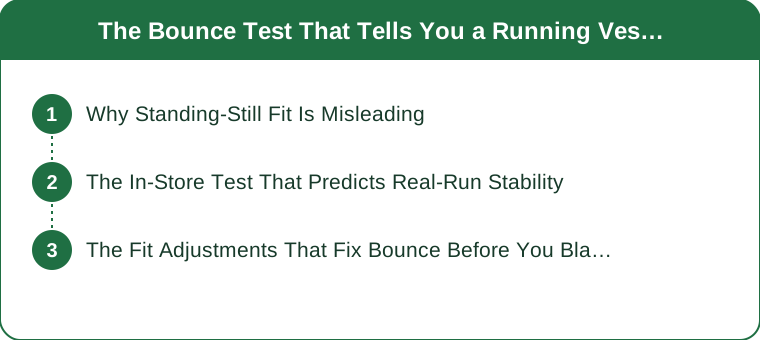
Why Standing-Still Fit Is Misleading
The static-vs-dynamic gap: the no-vertical-load-while-standing (the vest’s weight sitting passively rather than being thrown upward and down with each stride — the missing-impact-load), the the-straps-feel-tight-enough-at-rest (the snugness that satisfies while still failing to account for the extra give impact creates — the false-security), the the-water-weight-shifts-only-in-motion (the fluid inside a reservoir sloshing and redistributing only once you’re actually moving — the sloshing-only-when-moving), and the reframe (a vest that feels secure standing still telling you almost nothing about how it’ll behave at running pace).

The In-Store Test That Predicts Real-Run Stability
What to actually do before buying: the jog-in-place-fully-loaded (the testing the vest with bottles or a reservoir filled rather than empty — the loaded-test-only), the the-watch-for-vertical-bounce-at-the-chest (the checking specifically for up-down movement at the sternum strap during the jog — the chest-bounce-check), the the-try-a-few-quick-direction-changes (the side-stepping briefly to see if the vest shifts off-center as well as bouncing — the lateral-shift-check), and the frame (jogging in place fully loaded, watching for chest bounce and lateral shift, as the actual predictive test — standing still tells you nothing useful).
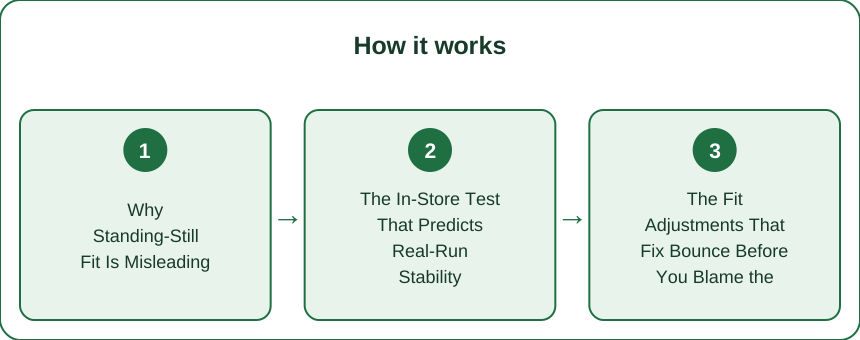
The Fit Adjustments That Fix Bounce Before You Blame the Vest
Before assuming it’s the wrong vest: the tighten-the-sternum-straps-first (the chest straps controlling most of the vertical bounce when properly snugged — the sternum-strap-priority), the the-check-load-placement-front-to-back (the weight distributed too far forward or back increasing bounce regardless of strap tightness — the balance-the-load), the the-re-test-after-each-adjustment (the jogging in place again after every tightening change rather than assuming one adjustment fixed it — the retest-every-change), and the frame (bounce usually being a fixable fit issue rather than a vest defect — tighten the sternum straps, balance the load, and retest before returning anything).
A hydration vest that feels secure while standing still can still bounce badly once you’re running, because standing still puts no vertical load on the straps and doesn’t account for the extra give that impact and shifting water weight create in motion. The test that actually predicts real-run stability is jogging in place fully loaded and watching specifically for chest bounce and lateral shift — not how it feels standing still. Before assuming the vest itself is the problem, tighten the sternum straps first since they control most vertical bounce, check whether the load is balanced front to back, and re-test after every adjustment rather than assuming one fix solved it.
Keep Reading
This article is for general informational and styling purposes only. Fit, sizing, and product availability may vary.