Why a Running Vest That Fit Perfectly Empty Bounces Once You Load It With Water
Quick Answer: A running vest that fits snugly empty can bounce once loaded with water because added weight — even just 1-2 liters — changes how the vest moves relative to your torso during each stride, and a fit that felt secure with no load often needs re-tightening once weight is added, since the straps were only tested against your body’s movement, not against moving water weight.
This is a load-testing gap, not a sizing mistake.

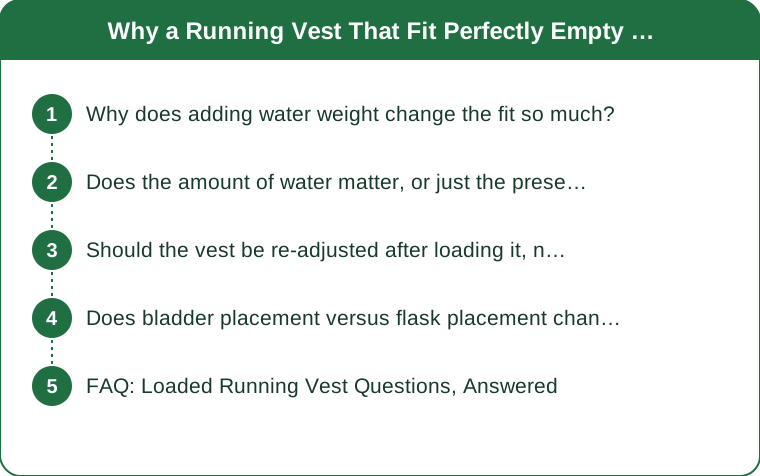
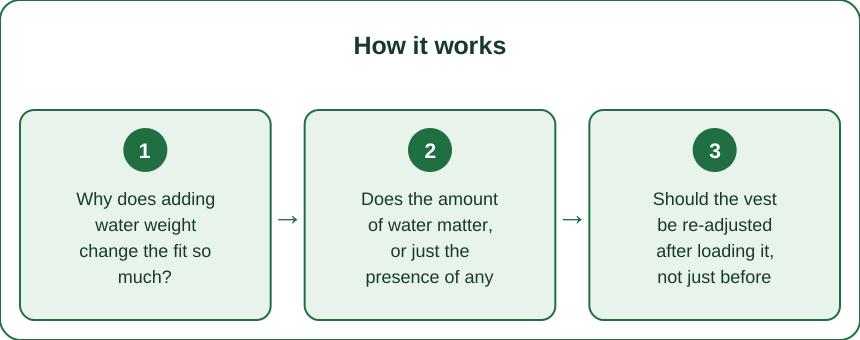
Why does adding water weight change the fit so much?
An empty vest moves with your body’s motion alone. Once loaded, the vest has its own independent momentum from the water’s weight and slight sloshing motion, which can move slightly out of sync with your torso’s motion during each stride — this mismatch is what shows up as bounce, even if the straps are technically still snug.
Does the amount of water matter, or just the presence of any weight?
Amount matters — even 500ml-1L can introduce noticeable bounce in a vest that was fit and adjusted empty, and bounce often increases somewhat with more volume, though a well-fitted vest with properly distributed weight handles higher volumes better than a poorly fitted one handles even a small amount.

Should the vest be re-adjusted after loading it, not just before the first fitting?
Yes — tightening straps after loading water, not just when trying the vest on empty, is the single most effective fix for this specific bounce. Many people fit the vest once when empty and never re-check after adding water, missing the adjustment that actually matters most.
Does bladder placement versus flask placement change the bounce pattern?
Somewhat — a back bladder concentrates weight higher and more centrally, while front flasks distribute weight lower and more to the sides. Neither placement is inherently bounce-free; both need the same re-tightening step once loaded, though some runners find front-loaded flasks easier to feel and adjust mid-run than a back bladder.
FAQ: Loaded Running Vest Questions, Answered
How tight should straps be once the vest is loaded?
Tight enough that the vest doesn’t shift when you jump in place, but not so tight it restricts breathing — a quick jump test after loading is a practical way to check.
Does bounce reduce naturally as water is consumed during a run?
Yes, generally — as water weight decreases through the run, bounce often decreases too, which is part of why a vest can feel different at mile 1 versus mile 8.
Is it worth practicing loaded runs before a race that requires carrying water?
Yes — testing the fully loaded vest on a training run, not just an empty fitting, is the only reliable way to know how it will actually behave under real race conditions.
TL;DR:
- Water weight gives a vest independent momentum that can move slightly out of sync with your stride
- Even a modest amount of water (500ml-1L) can introduce bounce in a vest fitted only when empty
- Re-tightening straps after loading water, not just fitting empty, is the most effective single fix
- Bounce typically decreases as water is consumed over the course of a run
If a vest bounces despite fitting perfectly at the store, the missing step is usually re-adjusting after loading it — not a sizing problem at all.
Keep Reading
This article is for general informational and styling purposes only. Fit, sizing, and product availability may vary.