Why a Running Vest That Fits Perfectly Standing Still Can Still Bounce Badly Once You're Running
Quick Answer: A running vest can feel perfectly snug standing still and still bounce badly on the run because you adjusted it against gravity, not against impact. Every footstrike sends vertical force through the vest that simply doesn’t exist in a fitting room. Fix it by loading the vest with its real water weight and jogging 30–60 seconds before you call the fit final.
You cinched the straps. You checked the mirror. Nothing moved. Two miles later the vest is slapping your sternum on every third stride and you’re wondering what changed.
Nothing changed. You just tested it under the wrong conditions.

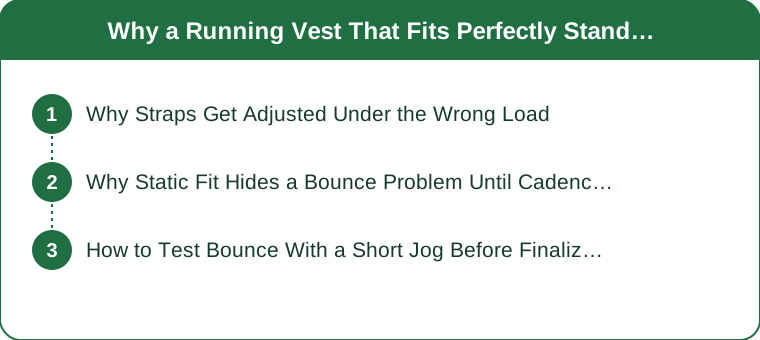
Why Does My Running Vest Bounce Even Though It Fits?
Because a standing fit test and a running fit test measure two different forces.
Standing still, the only load on the vest is gravity pulling straight down at 1g. The straps only have to hold the pack against your body under that steady, unchanging pull. Nearly any reasonably adjusted vest passes.
Running is a different problem. Each footstrike sends an impact spike up through your body, and depending on pace and surface, the vertical force at the point of contact runs roughly two to three times body weight. That force doesn’t disappear at your hips — it travels up the torso and hits the vest as a repeated upward-then-downward shove, about 160–180 times per minute at a normal cadence.
A strap tension that’s plenty against 1g of steady pull can be nowhere near enough against 170 shoves a minute. That’s the whole story.
Why Does the Fitting Room Hide the Problem?
Because the defect only exists under a condition the fitting room can’t produce.
Think about what a fitting room actually offers: a mirror, a flat floor, and you standing on it. There is no cadence. There is no footstrike. The single variable that causes vest bounce is entirely absent from the environment where almost everyone makes the buying decision.

There’s a second hiding place, too: weight. Most people try a vest empty, or with one half-full flask. On the trail it’s carrying 1.5–2 liters of water, which is 3.3–4.4 pounds, plus gels, a shell, and a phone. That load changes the vest’s center of mass and its momentum on every stride. An empty vest that sits beautifully can be a completely different object at 5 pounds.
So the two things that cause bounce — impact force and real load — are exactly the two things missing when the fit gets approved.
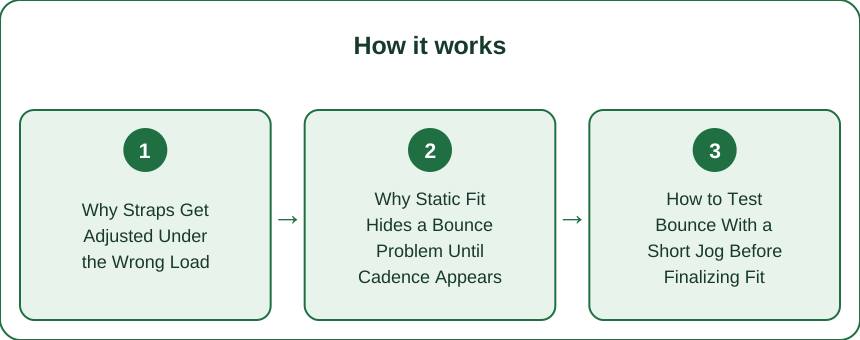
How Do You Test a Running Vest for Bounce Before Buying?
Do this in the store. It takes under a minute and it will feel slightly ridiculous. Do it anyway.
- Load it to race weight. Fill the flasks or bladder with actual water — most shops will let you, and if they won’t, ask to fill them at the water fountain. An empty-vest test is not a test.
- Jog in place for 30 seconds. Not a bounce, not a bob — an actual jog with your knees coming up and your feet leaving the floor.
- Then take a lap. Around the store, out to the sidewalk, wherever. 60 seconds of real running gait tells you more than ten minutes in front of a mirror.
- Listen, don’t just feel. A vest that’s slapping makes noise. If you hear rhythmic contact, you have bounce.
- Adjust while moving, not after. Tighten sternum straps mid-jog, then keep jogging. This is the only way to find the tension that actually holds under load.
The order of adjustment matters: sternum straps first, then side cinches, then shoulder straps. Most vests bounce because the side straps under the ribs are loose, and most people never touch those because they can’t see them in the mirror.
5 Fit Mistakes Almost Everyone Makes
- Testing empty. Covered above, and it’s the big one. Weight changes everything.
- Over-tightening the shoulders instead of the sides. Cranking the shoulder straps pulls the vest up into your armpits and does very little for bounce. The side cinches are what actually pin the load to your ribcage.
- Setting sternum strap height once and forgetting it. Most vests have sliding sternum strap rails. Moving the lower strap down 1–2 inches often kills chest slap entirely.
- Ignoring what you’re wearing. A vest fitted over a bare shoulder or a thin tank behaves differently over a winter jacket. Fit it in something close to what you’ll actually run in.
- Assuming bounce means “wrong size.” More often it means wrong adjustment, or the flasks are half-full and sloshing. A half-empty flask is a moving weight; a full one isn’t. The third mistake on this list fixes more vests than a size change does.
What Nobody Tells You About Sloshing
Bounce and slosh are different failures with different fixes. Bounce is the whole pack moving relative to your torso — a strap problem. Slosh is water moving inside the flask — a fill problem.
If a vest feels stable but you can hear liquid rolling, squeeze the air out of soft flasks before capping them, or run the bladder full rather than half. A 50%-full 2L bladder is the single sloshiest configuration you can carry.
FAQ
How tight should a running vest be?
Snug enough that you can’t get more than a flat hand between the vest and your sternum, but loose enough to take a full deep breath without restriction. If you can’t expand your ribcage fully at the top of an inhale, it’s too tight — and a too-tight vest causes chafing rather than solving bounce.
Can chafing be fixed by tightening the vest?
Usually the opposite. Chafing comes from the vest moving against skin, so if the rubbing is at the underarm or collarbone, the fix is stabilizing the load with the side straps, not squeezing harder. Anti-chafe balm on the contact points helps in the meantime.
Does vest bounce mean I bought the wrong size?
Not necessarily — try the adjustment sequence first (sternum height, then side cinches, then shoulders) with the vest at full race weight. If it still bounces at correct tension, or if the sternum straps are at their tightest setting, then it’s a size or a torso-length issue and it’s worth exchanging.
General guidance for recreational running. If a vest is causing persistent shoulder, neck, or rib pain rather than ordinary rubbing, stop using it and check in with a physio or sports medicine professional.
TL;DR:
- A standing fit test measures the vest against 1g of gravity; running loads it with 2–3× body weight, 170 times a minute
- The fitting room can’t produce the condition that causes bounce, so the defect stays invisible until mile two
- Test loaded (real water, race weight) with a 30-second jog in place plus a 60-second lap
- Adjust in this order: sternum strap height, then side cinches, then shoulders
- Bounce is a strap problem; slosh is a fill problem — a half-full bladder is the worst configuration
Keep Reading
This article is for general informational and styling purposes only. Fit, sizing, and product availability may vary.