Front Flasks Change Your Running Form More Than Back Weight Does
Quick Answer: Weight on the front of a vest sits ahead of your center of mass and restricts chest expansion, so it changes both your posture and your breathing. Weight in the back sits closer to your spine and mostly just adds load. Two full front flasks pull you slightly forward and can measurably reduce comfortable breathing depth, which is why a vest that feels fine empty feels different at the start of a run and fine again by the end.
You set the vest up perfectly. Snug, no bounce, straps even.
Then you filled both front flasks and it became a slightly different piece of equipment.

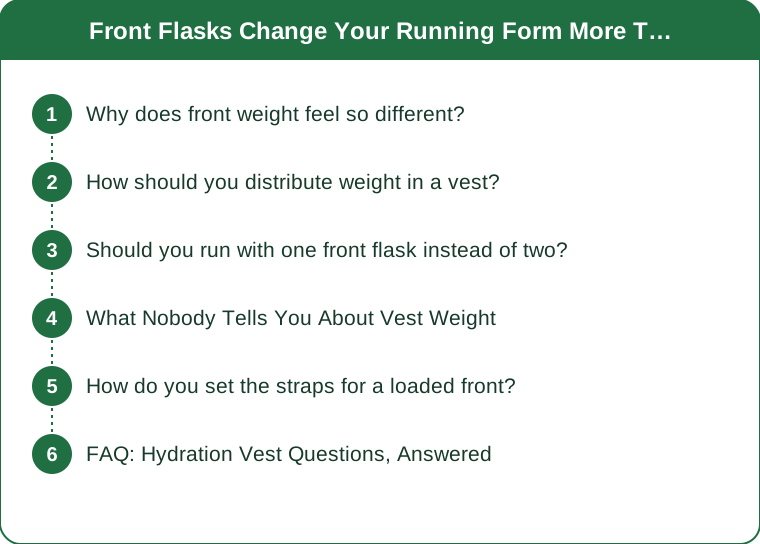
Why does front weight feel so different?
Two mechanisms, and they compound.
Leverage. Weight carried in front of your body sits further from your spine than weight carried against your back. Your postural muscles have to counter that offset continuously, usually by leaning very slightly forward or by tensing through the upper back. It is a small effect per step and a large one across 90 minutes.
Chest expansion. Two 500ml soft flasks sit directly over the upper ribs. When they are full and the straps are snug, they restrict the outward movement of your ribcage during inhalation. Most people compensate by shifting toward shallower, more upper-chest breathing, which is less efficient at any given effort.
The practical signature of this is distinctive: you feel slightly more breathless in the first 20 minutes of a run with full flasks than the same run with an empty vest, even though the pace is identical. Then it eases — partly because you drank some, partly because you adapted.
Back weight does neither of these. It sits close to the spine, does not touch the ribcage, and mostly registers as generic load.
How should you distribute weight in a vest?
The working principle: front for what you need often and light, back for what is heavy and can wait.
Front pockets: soft flasks (accepting the tradeoff), phone, gels, a buff. Keep total front load under about 1.5-2 lbs beyond the flasks themselves.
Back main compartment: jacket, extra water bladder, food, first aid, anything with mass. Pack heavy items high and close to your back, not low in the bottom of the pocket — low weight in the rear swings and pulls the vest down at the shoulders.
Side and rear-accessible pockets: the awkward middle ground. Good for a second soft flask you will move forward later, and for items you can reach without taking the vest off.
A distribution that works well for a long run: start with both front flasks full and the rear bladder full, and as you drink the front flasks, refill them from the rear reserve at the halfway point. That way the front load decreases when you are most fatigued and the front restriction matters most.
Should you run with one front flask instead of two?
For runs under about an hour, often yes — and it is an underused option.
A single front flask on one side creates a small asymmetry, which sounds bad but is usually less disruptive than the bilateral chest restriction of two. You get roughly half the chest-expansion penalty and you can shift the flask side at a natural break.
When two is clearly right: long runs, hot weather, technical terrain where you need balanced weight for stability, and any run where the asymmetry would persist for hours.
When one is fine: hour-long training runs in mild weather, anything with a water source, and any run where you are more limited by comfort than by hydration.
A third option most people skip: run with both flasks half full rather than one full. Same total water, weight split evenly, less bulk over each lung, and you get the balance without the full restriction. The half-full flasks slosh slightly more, which some people hate and others do not notice.

What Nobody Tells You About Vest Weight
Full flasks change your arm carriage. With bulky front pockets, your arms swing slightly wider to clear them. Over hours that widening shows up as upper back and shoulder fatigue that people usually blame on the straps.
The restriction is worse on climbs. Uphill running demands deeper breathing at exactly the moment your posture leans forward into the flasks. If you have ever felt like you cannot get a full breath on a climb with a loaded vest, this is why. Loosen the sternum straps before a long climb — one notch is often enough.
Sloshing is not just annoying, it is a load signal. A half-empty rigid bottle in a front pocket creates a small moving mass that your torso stabilizes every stride. Soft flasks collapse as they empty, which is the entire reason they exist. If you use rigid bottles up front, keep them full or move them back.
Front weight amplifies bra strap pressure. The vest’s front load presses through whatever is underneath it. Many complaints about vest chest chafing are actually vest-plus-bra-strap stacking. Check that the vest’s straps do not run directly over your bra straps — offsetting them by even half an inch often solves it.
The vest fits differently full than empty. Everyone fits their vest empty in the living room. Fit it loaded, standing, then jog 30 seconds and re-adjust. It will need different tension.
How do you set the straps for a loaded front?
The order matters, and most people do it backwards.
- Load the vest first. Flasks in, pack packed. Fitting empty guarantees you re-fit at mile one.
- Set the lower sternum strap first, snug but not tight. This is the one that controls bounce.
- Set the upper sternum strap loose. Its job is stopping the vest splaying outward, not compressing your chest. Tightening this one is the most common cause of restricted breathing.
- Adjust side cinches so the vest sits against your ribs without pinching. You should be able to slide a flat hand under the side panel.
- Take a maximal inhale. If the vest resists at the top of the breath, everything is a notch too tight. Loosen and repeat.
That last step is the one people skip, and it is the one that decides whether the vest is comfortable at effort. A vest fitted to a normal breath is too tight for a hard climb.
FAQ: Hydration Vest Questions, Answered
Why do I feel more out of breath with a vest at the same pace?
Some of it is real added work — carrying 3-4 lbs costs energy. But a meaningful part is chest restriction from front flasks and over-tightened upper sternum straps. Try the same run with one flask and a looser upper strap and see how much of the difference disappears. For most people it is a lot.
Should the flasks sit high or low in the front pockets?
High, with the valve reachable near your collarbone. Low-sitting flasks bounce more, pull the vest forward at the bottom, and are harder to drink from without slowing. Most vests have an internal loop or elastic to hold them up — use it.
Does vest weight matter for road running too?
Yes, though less. Road running has less stabilization demand so the balance issue matters less, but the chest restriction is identical. If you use a vest for long road runs, a waist belt with rear bottles is often more comfortable for the same water volume, precisely because it moves the load off your ribcage.
TL;DR:
- Front vest weight sits ahead of your center of mass and restricts ribcage expansion; back weight mostly just adds load.
- Keep front load light and frequently-needed; pack heavy items high and close to your back.
- One flask or two half-full flasks are legitimate options for shorter runs.
- Fit the vest loaded, set the lower sternum strap snug and the upper one loose, and test with a maximal inhale.
- Loosen the sternum straps before long climbs, when you need the deepest breathing.
The adjustment worth making tomorrow is the simplest one on the list: loosen the upper sternum strap a notch and take a full breath. If that breath is noticeably easier than the one you have been taking on every run this year, you have just found several minutes of free comfort per hour.
Keep Reading
This article is for general informational and styling purposes only. Fit, sizing, and product availability may vary.