Why Your Hydration Vest Still Bounces Even Though It's Tightened Correctly
Quick Answer: Bounce often comes from how weight is distributed within the vest — unevenly loaded pockets or water concentrated in one spot — rather than from overall strap tightness, meaning a vest can be pulled as tight as comfortably possible and still bounce if the load inside is sitting away from the body’s center of mass or shifting with each stride.
Tightening straps controls how snug a vest sits against the body, but it doesn’t control where the weight inside that vest actually is — and that’s usually the real source of bounce.

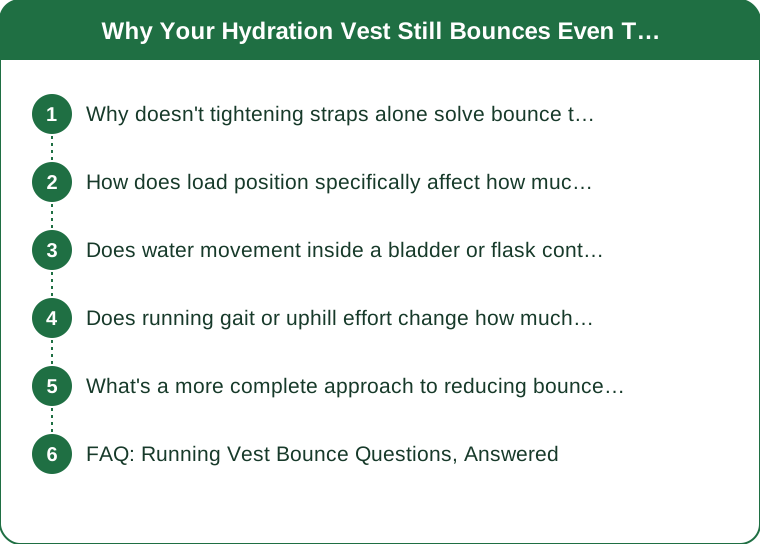
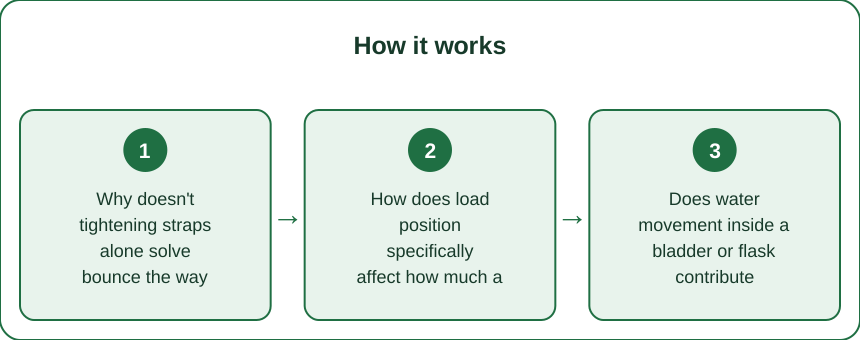
Why doesn’t tightening straps alone solve bounce the way most people expect?
Strap tightness controls how closely the vest sits against the torso, but it doesn’t change where load is concentrated within the vest itself — a heavy water bladder or dense items sitting low or off-center still has momentum that moves somewhat independently of the body during running, even in a snugly fitted vest, since no amount of strap tension fully eliminates the vest’s own internal mass shifting slightly with each stride.
How does load position specifically affect how much a vest bounces?
Weight positioned close to the body’s center of mass (front pockets near the chest, close to the spine) moves more in sync with the torso’s natural motion than weight positioned lower or further from center, so redistributing heavier items toward the front and center of a vest, rather than concentrated in a lower back pocket, often reduces bounce more effectively than additional strap tightening.
Does water movement inside a bladder or flask contribute independently to bounce?
Yes, meaningfully — a partially full water bladder allows liquid to slosh and shift with each stride, creating its own small momentum separate from the vest’s overall position, which is part of why a vest can feel more stable either completely full or genuinely low, and noticeably bouncier specifically when a bladder is partially full and has room for liquid to move.

Does running gait or uphill effort change how much a given vest setup bounces?
Yes — more vertical oscillation in a runner’s natural gait, and particularly uphill running, which tends to increase vertical bounce in general, both amplify how much a vest’s load shifts, meaning a vest that feels stable on flat, efficient running can bounce noticeably more on hillier terrain even with identical strap tightness and packing.
What’s a more complete approach to reducing bounce beyond just strap tension?
Prioritizing front-loaded weight distribution, keeping a water bladder either mostly full or mostly empty rather than partially full when possible, and choosing a vest with a genuinely snug, low-profile front pocket design tend to address bounce sources that strap tightening alone can’t reach, making load distribution as important a fitting consideration as strap adjustment itself.
FAQ: Running Vest Bounce Questions, Answered
Is a vest with more pockets and compartments always better for reducing bounce?
Not necessarily — more compartments can help distribute weight deliberately, but a vest with too many loosely packed pockets can actually increase bounce if items inside aren’t secured tightly within each compartment.
Does vest size (versus just strap tightness) matter for bounce?
Yes — a vest sized correctly for torso length and shape generally allows for a more even, secure fit than an ill-fitting vest overtightened to compensate, since overtightening a wrong-sized vest often creates uneven pressure points rather than solving the underlying fit mismatch.
Should hydration flasks in front pockets be preferred over a back bladder for bounce-sensitive runners?
Often yes — front-carried flasks keep weight close to the center of mass and are easier to keep secure and full, which tends to produce less noticeable bounce than a single larger back-positioned bladder for runners particularly sensitive to vest movement.
TL;DR:
- Strap tightness alone doesn’t control where weight inside a vest is actually distributed
- Load positioned close to the body’s center of mass bounces less than load carried low or off-center
- A partially full water bladder sloshes and adds its own bounce-generating movement
- Uphill running and higher vertical oscillation amplify bounce from the same vest setup
- Front-loaded packing and full-or-empty bladder management address bounce sources tightening can’t
Bounce is a load distribution problem as much as a fit problem — solving both matters more than cranking straps tighter.
Keep Reading
This article is for general informational and styling purposes only. Fit, sizing, and product availability may vary.