Why Your Running Vest Behaves Completely Differently Going Down Than Going Up
Quick Answer: Descending produces higher vertical impact forces and a longer flight phase than climbing does, so a vest that stays put uphill can bounce significantly downhill. Uphill running is also slower with a more forward torso lean, which presses the pack into your back. The fix is to set the vest up on flat ground with the load you will actually carry, tighten the sternum straps last, and pack front and back weight symmetrically - then test it on a short descent before committing to a long one.
The vest was perfect for the whole climb.
Then you turned around and it spent forty minutes hitting you in the shoulder blades.

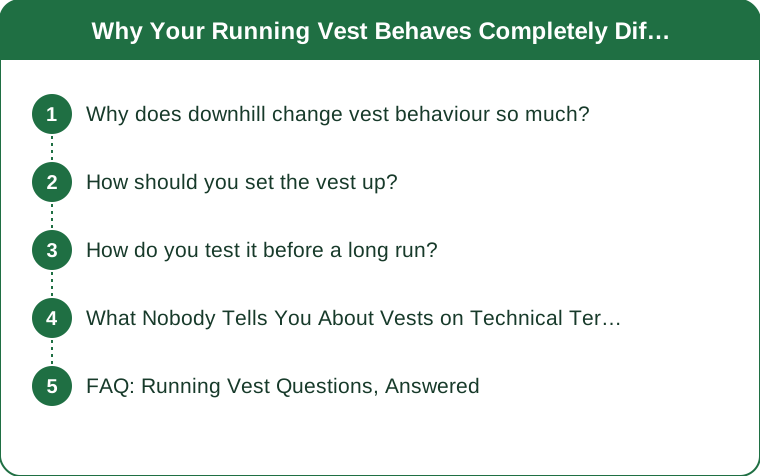
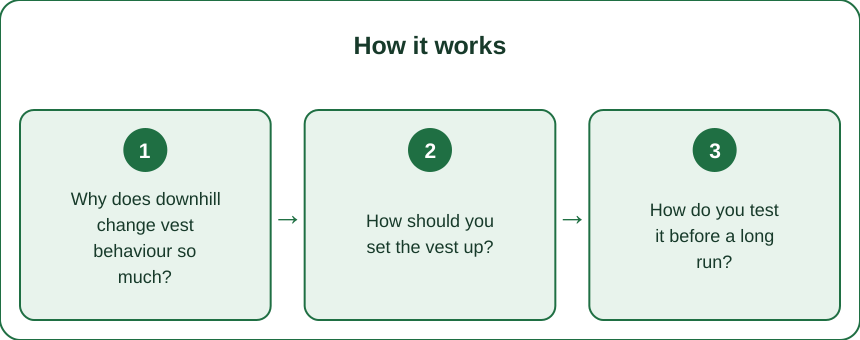
Why does downhill change vest behaviour so much?
Descending produces higher vertical impact forces than level or uphill running, because you are landing from a greater effective height with each stride.
Flight time is longer on descents, which gives the load time to separate from your torso before you land - and the separation is what you feel as bounce.
Uphill running has a forward torso lean that presses the pack against your back, effectively holding it in place. That support disappears the moment the gradient reverses.
Cadence rises on descents for many runners, so the frequency of loading goes up as well as the magnitude.
And you are braking. Downhill running involves substantial eccentric deceleration, which introduces forward-backward movement of the load that climbing does not.
The result is that a descent is the real fit test, and setting up a vest on the climb tells you very little about how it will behave later.
How should you set the vest up?
On flat ground, fully loaded with what you will actually carry. An empty vest fitted in a shop bears little relation to a full one on a trail.
Tighten the shoulder or front adjusters first, then the side straps, then the sternum straps last.
Position the upper sternum strap high, near the collarbone, which is what stops the shoulder straps splaying outward on impact.
Sternum strap position matters more than overall tightness, and it is the adjustment most people never touch.
Pack front and back symmetrically. Two half-full front flasks and a heavy rear load is the configuration that bounces worst.
Fill flasks completely or not at all. A half-full soft flask sloshes, and the moving water is a genuine and underestimated source of instability.
Push soft goods - jacket, gloves - to the bottom of the rear pocket so the load sits low and close rather than high and loose.
And recheck after adding or removing a layer, since a jacket under the straps changes the geometry completely.

How do you test it before a long run?
Jump ten times on the spot with the vest loaded. If it moves noticeably, it will be worse at hour three.
Then run 200 metres downhill, which is the actual test and takes two minutes.
Run a short section uphill too, since a vest tightened aggressively for descents can restrict breathing on a climb.
Check for a single-sided rub, which usually indicates asymmetric packing rather than an asymmetric body.
Reach for each front pocket while running, since pockets that are accessible standing still are frequently unreachable in motion.
Do this with the layers you will actually wear, including the jacket you plan to add later.
And note that a vest which needs to be uncomfortably tight to stop bouncing is the wrong size or the wrong load distribution - tightness is not the solution to a packing problem.
What Nobody Tells You About Vests on Technical Terrain
Bounce comes from loading, not from tightness, far more often than people assume. The instinct on feeling bounce is to pull every strap harder, which restricts breathing and produces shoulder chafing without fixing the cause. Repacking usually works better than retightening.
A half-empty soft flask is the worst possible state. Full flasks are stable, empty flasks are light, and half-full flasks slosh with every stride - which is why vests often feel worse an hour in than at the start, exactly when people blame the fit.
Descending is when chafing actually happens. The higher forces and increased movement mean the majority of vest chafe reports trace to descents, even though people notice it later. Balm at the underarm and collarbone before a hilly run is worth the thirty seconds.
Your fit changes with the season, not just with the load. A vest dialled in over a summer singlet sits completely differently over an autumn long-sleeve and jacket, and the first cold-weather long run is a common time for a previously perfect vest to suddenly misbehave.
Front pocket access is a design feature people evaluate in a shop while standing still, which is the one situation where it does not matter. Test reachability at a run.
Weight high in the rear pocket is the most common packing error. Soft goods at the bottom and dense items low and central keeps the load close to your centre of mass, which reduces both bounce and the shoulder load on descents.
And a vest that fits perfectly for you may be a poor fit for someone with a different torso length regardless of chest size - torso length, not chest circumference, is what determines whether the pack sits where it should.
FAQ: Running Vest Questions, Answered
Why does my vest bounce downhill but not uphill?
Descents produce higher vertical forces and longer flight time, and the forward lean of climbing presses the pack into your back. Downhill is the real fit test.
Should I just tighten it more?
Usually not. Bounce is more often a packing problem than a tightness problem, and over-tightening restricts breathing and causes shoulder chafing.
Where should the sternum straps sit?
The upper strap high near the collarbone, which prevents the shoulder straps splaying on impact. Position matters more than tension.
Why does it feel worse an hour into the run?
Most commonly because your flasks are now half-full and sloshing. Fill completely or consolidate into one full flask.
How do I stop one-sided chafing?
Check packing symmetry first - it is usually an unbalanced load rather than an asymmetric body. Then check strap adjustment on both sides matches.
Do I need to refit when I add a jacket?
Yes. Any change in layer thickness changes how the straps sit, and the first cold-weather run is a common time for a previously good fit to fail. This is general information, not medical advice.
TL;DR:
- Descents produce the highest vertical forces and longest flight phase - that is where vests bounce.
- Climbing hides the problem because the forward lean presses the pack into your back.
- Set up on flat ground fully loaded; tighten sternum straps last and position them high.
- Half-full soft flasks slosh - fill completely or consolidate.
- Pack soft goods low, dense items low and central, and keep front and back symmetrical.
- Test with ten jumps and a 200 metre descent before any long run.
Bounce is usually a packing problem, not a tightness problem. This is general information, not medical advice.
Keep Reading
This article is for general informational and styling purposes only. Fit, sizing, and product availability may vary.