Why Your Vest Bounces Only When It Is Half Empty
Quick Answer: A vest bounces when contents can move inside the pockets — which happens at partial load, not at full or empty. Fix it by compressing the load rather than tightening the straps: fill dead space, keep weight high and close to the spine, use the compression straps as the fluid level drops, and re-tighten the front adjusters mid-run, since they loosen as the load lightens.
At the start it was perfect. Two full flasks, a packed rear pocket, everything locked in place.
An hour later one flask is empty, you have taken a layer off and shoved it in the back, and now the vest is moving on every stride — slapping at the shoulders, shifting side to side, and gradually rubbing.
It is the same vest, adjusted the same way. What changed is the distribution of what is inside it.

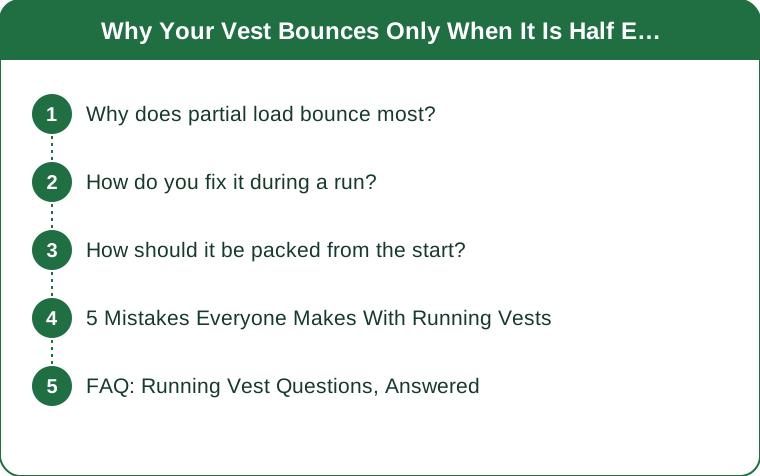
Why does partial load bounce most?
Because a partial load has room to move, and moving mass is what produces bounce.
A full vest is self-compressing. Contents press against each other and against the fabric, so nothing can shift. The whole load moves with your torso.
An empty vest has no mass to move. There is nothing to generate force, so it stays put even if it is loose.
A half-empty vest has both mass and space. Every stride, the contents accelerate downward, hit the bottom of the pocket, and transfer that impulse into the vest — which then pulls on the straps. The vest is not loose; the load inside it is.
Half-empty soft flasks are the specific culprit. A soft flask with 250ml in it sloshes, and the liquid moving inside the flask adds a second, out-of-phase motion. This is why the bounce often starts precisely when a flask is half gone.
And the straps genuinely do loosen. As total weight drops, the elastic and webbing relax, so the fit that was correct at the start is measurably looser an hour later.
How do you fix it during a run?
Three actions, in order, and none of them is simply tightening everything.
Consolidate the load first. Move remaining contents so they fill the space rather than sit at the bottom of a pocket. Combine two half flasks into one if you can. Push a stowed jacket into the space rather than letting it sit loose.
Use the compression straps. Most vests have side or rear compression that reduces internal volume. This is the correct tool and the one people forget exists — it removes the space rather than squeezing your ribs.
Then re-tighten the front adjusters. Only after compressing. Tightening the front to compensate for a loose load restricts breathing without stopping the bounce, because the mass inside is still free to move.
Keep weight high and close to the spine. The higher and closer the mass, the shorter the lever and the less it can swing. Heavy items at the bottom of a rear pocket produce noticeably more movement than the same items packed high.
A thirty-second stop is worth it. Runners consistently endure a bouncing vest for an hour rather than stopping to repack, and the repack takes less time than a single hill.

How should it be packed from the start?
Anticipating that the load will lighten, which most packing does not.
Pack for the mid-run state, not the start. You know a flask will empty and a layer will come off. Leave the space where those changes will happen adjacent to something that can expand into it.
Heaviest items high and centred. Against the upper back, close to the spine. Lightest and bulkiest low and outward.
Fill dead space with soft items. A buff, gloves, a packed jacket. Empty space is the enemy, and soft items are the cheapest way to remove it.
Front pockets balance the back. Weight in front flasks counteracts rear load and keeps the vest stable through torso rotation. A vest loaded only at the back pulls backward and rides up at the front.
Test it loaded, running, before a long day out. A vest that feels fine walking around a shop tells you nothing. Ten minutes of running with a realistic load reveals every problem, and it is the step almost nobody takes before a race.
5 Mistakes Everyone Makes With Running Vests
1. Tightening the straps to stop the bounce. It restricts breathing and does not address the cause. Compress the load first, then adjust.
2. Never re-adjusting mid-run. The fit that was right at kilometre one is loose at kilometre fifteen, because the load has lightened. Two adjustments over a long run is normal practice.
3. Packing heavy items low. Longer lever, more swing, more shoulder fatigue. Heavy goes high and against the spine.
4. Ignoring a rub until it becomes a wound. Vest chafing at the underarm, collarbone or sternum starts as warmth and becomes raw skin surprisingly quickly, especially with a wet shirt. The third mistake causes discomfort; this one ends the day — stop and fix it at the first sensation.
5. Sizing by chest measurement alone. Vest fit depends on torso length as much as circumference. A vest that is the right size around but too long for your torso will bounce no matter how it is packed, because the load sits below your centre of mass.
FAQ: Running Vest Questions, Answered
How tight should a vest actually be?
Snug enough that you can slide a flat hand under the front straps but not a fist, and tight enough that it does not lift off your back when you jump on the spot. If you cannot take a full deep breath, it is too tight and the problem is probably the load, not the fit.
Why does it chafe on one side only?
Usually an uneven load, an asymmetric strap adjustment, or a seam in your base layer sitting under the strap. Check the load balance first — a single full flask on one side is a common and easily missed cause.
Can I use a vest for road running?
Yes, and it is often better than a handheld bottle for anything over about 90 minutes. Load it lighter than you would for trail, keep the weight high, and be aware that road running’s more consistent cadence makes any bounce more noticeable and more irritating over time.
TL;DR:
- Vests bounce at partial load because contents have both mass and space to move — full and empty are both stable.
- Fix it by compressing the load, not tightening the straps: consolidate contents, use the compression straps, then re-adjust the front.
- Pack heavy high and against the spine, fill dead space with soft items, and balance front against back.
- Re-adjust mid-run as the load lightens, and stop at the first sign of rubbing rather than at the first sign of damage.
The half-full bounce is one of those problems that feels like an equipment fault and is almost always a packing one. Thirty seconds spent consolidating a load at the point a flask empties is the difference between a comfortable second half and two hours of being slapped in the shoulders — and once you know to expect it at that specific moment, it stops being a surprise.
Keep Reading
This article is for general informational and styling purposes only. Fit, sizing, and product availability may vary.