Why Your Vest Fit Needs Rechecking Every Time You Change Layers
Quick Answer: A running vest is fitted to a specific torso circumference, and every layer you add changes that circumference by a meaningful amount. Straps set over a thin summer top are too tight over a jacket, which restricts breathing and creates pressure points; straps loosened for bulk are too loose once you remove the jacket mid-run, which produces bounce and chafing. Refit the vest whenever the layers change - and expect to do it twice on any run where you start cold and warm up.
Here is what shifts, and a fast way to reset it.

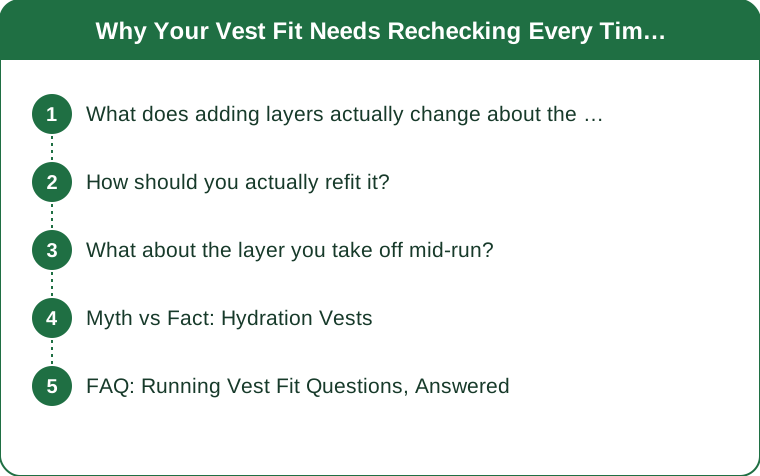
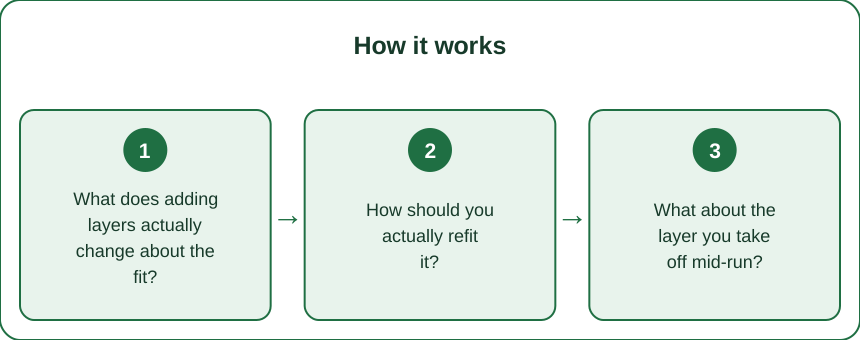
What does adding layers actually change about the fit?
More than the obvious circumference, and the secondary effects cause the actual problems.
Torso circumference increases with every layer. A long-sleeve top plus a light jacket adds a genuinely measurable amount around the chest and ribs, which is well beyond the tolerance most vests are designed around. The strap setting that was correct is now compressing.
Compression restricts breathing. A vest strap across the ribs that was comfortable over one layer limits chest expansion when tightened over three, and the effect appears at exactly the moment you need full breathing - going uphill or picking up the pace.
Slippery fabric changes how the vest sits. A vest over a smooth jacket moves differently from a vest over a textured top. The friction that quietly held it in place is gone, and the vest starts sliding - usually upward toward the neck or laterally on turns.
Layer bulk changes the load path. The pack is now sitting on compressible material rather than close to your torso. Compressible layers under a loaded vest allow movement, and movement is bounce.
And you will remove a layer mid-run. This is the part people never plan for. The fit you set at the trailhead is wrong within thirty minutes once the jacket comes off and goes into the vest - which also just added weight to the back.
Which is why autumn is when people suddenly report vest problems they never had in summer: the fit is now a moving target across a single run, not a fixed setting.
How should you actually refit it?
A short sequence that takes under a minute once you know it.
Fit over the layers you will be wearing at the coldest point, then plan for loosening rather than tightening. It is far easier to take up slack mid-run than to create room.
Set the sternum straps first, and check breathing before anything else. Take a deliberate full breath. If your chest cannot expand fully, it is too tight regardless of how stable the vest feels. This is the check people skip and it is the most important one.
Then check for bounce with a proper test. Jog on the spot for fifteen seconds and jump twice. Movement of more than a couple of centimetres means it needs tightening, but only after the breathing check passes.
Adjust the side straps rather than over-tightening the front. Most vests have both, and side adjustment changes the fit without adding chest compression - which is exactly what layered fitting needs.
Set strap heights, not just tension. Sternum strap positions matter more with layers, because bulk changes where a strap naturally sits. A strap that lands on the wrong part of the ribcage will be uncomfortable at any tension.
And re-check at 20 minutes. Layers settle, you warm up, the load shifts as you drink. One planned adjustment early prevents an hour of small irritations, and it is faster than stopping repeatedly later.

What about the layer you take off mid-run?
This is the specific scenario that causes most autumn vest complaints, and it has a specific solution.
Removing a jacket does two things at once. Your torso gets smaller, so the vest is now loose, and the jacket goes into the vest, so the vest is now heavier. Loose plus heavier is the exact recipe for bounce and chafing.
Plan where the jacket goes before you start. A rear pocket keeps the weight centred; stuffing it into a front pocket unbalances the vest forward and changes the strap tension on one side. Around the waist works but adds a friction point at the hem.
Retighten immediately, not at the next stop. Ten seconds of adjustment prevents the rubbing that accumulates over the following miles. Chafing from a loose vest is cumulative and it does not undo itself when you tighten later.
Consider whether you need the jacket at all. Given how much simpler the vest fit is with a stable layer count, starting slightly cold in a single layer with gloves and a headband is frequently the better setup for a vest run - the extremities do the temperature regulation and the torso stays constant.
And be careful with the front pockets specifically. Soft flasks in front pockets change the strap geometry as they empty, which is a separate slow-moving fit change happening throughout the run. A half-empty flask sits differently from a full one, and that plus a layer change compounds.
One habit worth building: carry the jacket at the start rather than wearing it, if the run is short enough. A constant layer count means a constant fit, and a constant fit is what makes a vest disappear.
Myth vs Fact: Hydration Vests
Myth: Tighter is always more stable. Fact: Beyond a certain point, tightening restricts breathing without improving stability. A properly positioned vest at moderate tension outperforms a badly positioned one cranked tight.
Myth: Bounce means the vest is too big. Fact: Bounce usually means the load is poorly placed or the straps are set wrong. A correctly loaded vest at the right size bounces very little, and repacking often fixes what a size change would not.
Myth: The vest fit is a one-time setup. Fact: It changes with layers, with load, with how much you have drunk, and across the seasons. It is a setting to check, not a setting to establish.
Myth: Chafing under a vest is inevitable on long runs. Fact: Most vest chafing comes from movement, which comes from fit. A stable vest over a smooth base layer chafes remarkably little, even over hours.
Myth: Front flasks and rear bladders are interchangeable. Fact: They load the vest differently and they change differently as you drink. Front flasks alter strap geometry as they empty; a rear bladder keeps the change centred but is harder to refill.
The one that surprises people: the most common cause of a vest that feels wrong in autumn is not the vest at all. It is that the person is now wearing two more layers than when they last adjusted it - and never reset it.
FAQ: Running Vest Fit Questions, Answered
Why does my vest bounce now when it did not in summer?
Because added layers are compressible, so the load can move against them, and your strap settings are calibrated to a smaller torso circumference. Refit over your current layers.
How tight should the sternum straps be?
Tight enough that a fifteen-second jog and two jumps produce minimal movement, but loose enough that you can take a full deep breath. The breathing check comes first.
What do I do when I take my jacket off mid-run?
Stow it in a rear pocket to keep the weight centred, then retighten immediately. Loose plus heavier is what causes chafing, and it accumulates over the following miles.
Should I fit the vest over my warmest or lightest layers?
Over the layers you will wear at the coldest point, then loosen if needed. Taking up slack mid-run is much easier than creating room.
Why does one side chafe and not the other?
Usually uneven loading - a heavier front pocket, a flask on one side, or a strap set at a different height. Check the pack contents before blaming the vest.
Do soft flasks change the fit as they empty?
Yes, they change the strap geometry gradually through the run. It is a slow-moving fit change that compounds with any layer change you make.
TL;DR:
- Every layer changes your torso circumference, and vest straps are set to a specific one.
- Too tight over layers restricts chest expansion - and that shows up exactly when you go uphill.
- Layers are compressible, so a loaded vest can move against them. That movement is bounce, and bounce becomes chafing.
- Refit sequence: fit over your coldest-point layers, check breathing first, then test bounce with a jog and two jumps.
- Adjust side straps rather than over-tightening the front, and set strap heights as well as tension.
- When the jacket comes off: stow it in a rear pocket and retighten immediately - loose plus heavier is the chafing recipe.
- Re-check at 20 minutes. Layers settle, flasks empty, and the fit is a moving target across the run.
A constant layer count is what makes a vest disappear. Gloves and a headband beat a jacket you will remove.
Keep Reading
This article is for general informational and styling purposes only. Fit, sizing, and product availability may vary.